Gartner, one of the leading research and consulting firms in information technology, has identified the ten key strategic technology trends for 2023.
Technology is constantly evolving, and with it come new opportunities and challenges. As you read this sentence, you are likely already experiencing some of these trends or even working on their development.
According to the company: "Business and technology leaders can use this list to assess the potential impact of technology trends on their specific strategies, such as revenue growth, digital acceleration, data value maximization, or brand protection and development."
Below, we will explore each of these trends and the impact they may have on the future of technology.
What will the priorities be?
The technology outlook for 2023 should help identify business priorities to be addressed. These trends are expected to shape corporate tactics over the next three years, enabling organizations to tackle these four key priorities:
Optimizing resilience, operations, or trust.
Scaling vertical solutions, product delivery, or reach everywhere.
Pioneering customer engagement, accelerated responses, or opportunity.
Pursuing sustainable technology solutions
10 Major Technology Trends
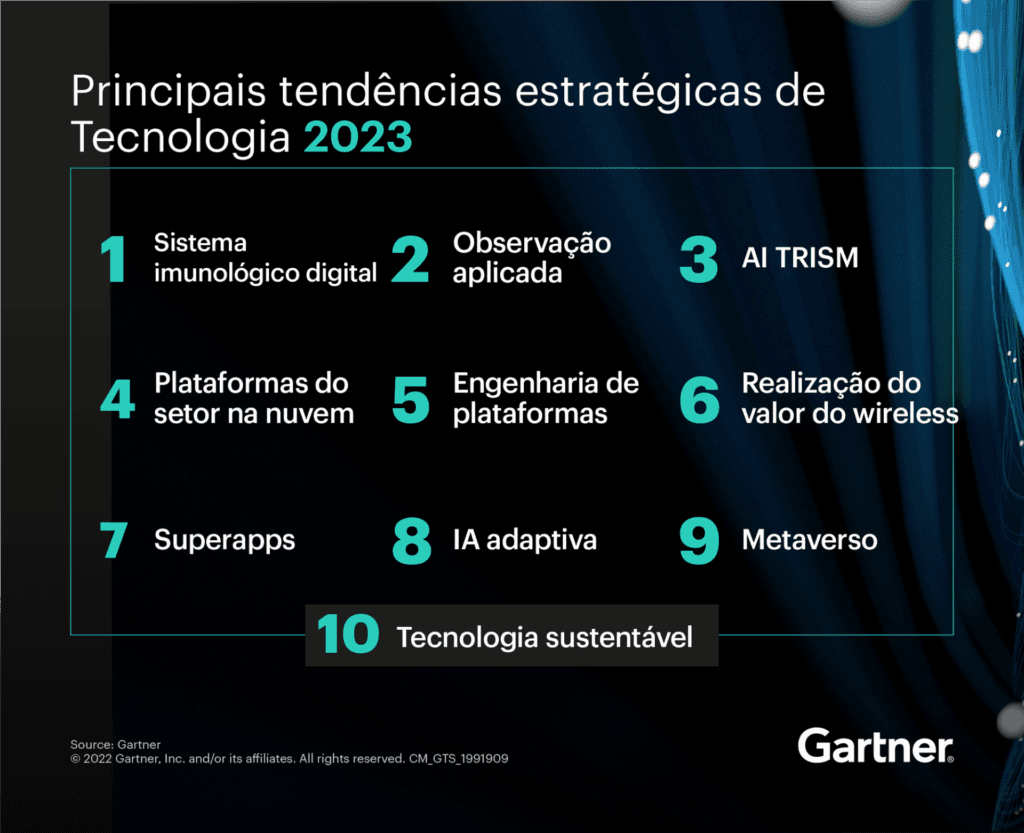
How will they correlate with the priorities?
1. Optimize
First, these trends optimize IT systems for greater reliability, improve data-driven decision-making, and maintain the value and integrity of artificial intelligence (AI) systems in production.
The digital immune system creates an enhanced customer experience by combining multiple software engineering strategies to protect against risks. Through extreme observation, automation, design, and testing, it delivers resilient systems that minimize operational and security risks.
Applied observability works with data emitted by an organization, using AI to analyze and make recommendations that allow a company to make faster and more accurate future decisions. When applied systematically, it can reduce response latency and optimize business operations in real-time.
AI TRiSM supports the governance of artificial intelligence models, reliability, fairness, security, robustness, effectiveness, and data protection. It combines methods to explain AI outcomes, rapidly implement new models, actively manage AI security, and enforce ethical and privacy controls.
2. Scale
Second, technology trends accelerate vertical offerings, increase product delivery pace, and enable connectivity everywhere.
Industry cloud platforms combine SaaS (Software as a Service), PaaS (Platform as a Service), and IaaS (Infrastructure as a Service) with industry-specific, tailored functionality that organizations can use to adapt more easily to the relentless flow of disruptions within their industry.
Platform engineering delivers a curated set of tools, resources, and processes packaged for easy consumption by developers and end users. It will increase end-user productivity and reduce the burden on development teams.
Realizing wireless technology value covers the provision of wireless network services, including traditional end-user computing, support for edge devices, digital engagement solutions, and more. These networks go far beyond pure connectivity, delivering location and other real-time information and insights through analytics, and enable systems to harvest energy from the network directly.
3. Pioneer
Given that, these trends focus on enabling business model change, reinventing employee and customer engagement, and accelerating strategies to explore new virtual markets.
Superapps are more than composite applications that aggregate services. A superapp combines the capabilities of an app, a platform, and an ecosystem in a single application, providing a platform for third parties to develop and publish their own miniapps.
Adaptive AI enables model behavior to change after deployment, using real-time feedback to continuously train models and learn within development and runtime environments, based on new data and adjusted goals to quickly adapt to changes in real-world circumstances.
The metaverse enables people to replicate or enhance their physical activities. This could happen by transporting or extending physical activities into a virtual world or transforming the physical world. It is a combinatorial innovation composed of multiple technology resources and themes.
4. Sustainable Technology
Moreover, simply delivering technology will not be enough in 2023. Sustainable technology is a solutions framework that increases the energy and efficiency of IT services; enables business sustainability through technologies such as traceability, analytics, emissions management software, and AI; and helps customers achieve their own sustainability goals.
In this way, investments in sustainable technology also have the potential to create greater operational resilience and financial performance, opening new paths for growth.
Is your business ready for these trends?
As we have seen, Gartner's 10 strategic technology trends will help meet business demands to improve, expand, or innovate.
However, these trends enable the connection between technological innovation and the organization's future strategic objectives.
In order for investments in sustainable technologies to offer operational and financial benefits, as well as generate development opportunities.
To learn more, you can also download the ebook on the 10 major trends.
Full text: https://www.gartner.com.br/pt-br/artigos/dez-principais-tendencias-estrategicas-gartner-2023