
Every finance leader knows this feeling: the company grows, demands increase, deadlines shrink, and expectations rise.
But while the team size stays exactly the same… pressure for efficiency accelerates fast, the need for precision is non-negotiable, and operational complexity only increases.
And despite all this, headcount remains frozen.
Meanwhile, what should be routine becomes a race. The team operates at capacity. Closings become marathons. Budgets require brute force. Forecasts depend on the goodwill of spreadsheets.
The worst part is that in such contexts, every delivery comes with some workaround to "make it work". This isn't a lack of competence: it's a lack of capacity.
Finance has become a strategic function trapped in an operational structure that can't keep pace with the business.
This is the paradox of modern Finance. And this is exactly where the conversation about scaling results without expanding the team begins.
But before the solution, you need to understand the causes. Keep reading!
The real culprit: the invisible cost of manual operations

When you observe the finance team's day-to-day work, it's not necessarily the analysis piece that consumes time. It's all the work that needs to happen before that phase even starts.
It's hours wasted consolidating data, fixing broken formulas, adjusting conflicting spreadsheet versions, and reviewing information to ensure nothing got overwritten in the process.
It's a giant machine that spins silently, but consumes most of the team's energy.
And this cost is much larger than it appears. In fact, you can estimate how much you're losing with spreadsheets using our ROI calculator.
The fact is, with each cycle, Finance must deal with multiple versions of the same file, each circulating through different teams, generating parallel revisions and demanding endless checks to discover which is the reliable number.
In other words, companies become overwhelmed by multiple versions, manual consolidation, and security concerns because spreadsheets simply don't deliver the governance necessary for critical processes.
This environment creates three deep problems:
1. Constant rework
Every change requires a new round of validation. Every manual input can generate an error.
Every change to a spreadsheet structure can break invisible formulas, creating inconsistencies that are hard to identify. Time that should go to projections, forecasts, and scenarios is lost in operational maintenance.
2. Lack of confidence in the numbers
When the team needs to consolidate everything manually, the question "Which is the right version?" becomes part of the routine.
Mitra's platform highlights this point: the traditional spreadsheet-based model makes auditing, data traceability, and security difficult, making review processes much longer and riskier.
3. Key person bottleneck
When the process depends on whoever "understands" the spreadsheet, operational risk increases. One absence and the process stalls. One human error and you create a mistake that can escalate quickly across the entire company.
In the end, what seems like just an operational problem becomes a strategic loss.
Every hour spent fixing spreadsheets is an hour that's lost forever.
Every manual consolidation is a deviation from what actually generates value.
This is how finance, even though experienced and dedicated, ends up operating at capacity. Not because talent is lacking: it's because structure is lacking. And it's exactly this invisible cost that prevents the team from delivering on its potential.
If you want to see how your financial operation works without multiple versions, without manual consolidation, and without error risk, test Mitra and experience a complete workflow without spreadsheets.
3. The domino effect: when the team operates at capacity, strategy dies

When operations are always at capacity, the impact isn't confined to finance. It spreads across the entire company, like a silent domino effect.
The team does deliver, but at the cost of manual effort, fine-tuning, long nights, and an almost exclusive focus on "keeping up with the basics". And when this happens, strategy inevitably takes a back seat.
Direct or indirect consequences show up in these ways:
#01 Decisions become slower
If every simulation depends on opening heavy spreadsheets, adjusting formulas, and manually consolidating inputs, any strategic question becomes a mini-project.
When leadership asks: "What happens if we reduce price by 3 percent?", "What if we accelerate CapEx?", "What's the impact of this supplier cost change?", Finance can't respond with the speed the business demands.
➦ And this compromises decision-making in areas that need agility to survive.
#02 Analytical quality deteriorates
When the team spends most of its time cleaning, adjusting, and consolidating data, there's very little mental space left for thinking.
Analyses become shallow instead of deep. The team's intellectual energy, which should be directed toward insights, projections, and modeling, gets trapped in operations.
#03 The team becomes reactive
Without predictability and without automation, the financial calendar becomes a permanent race. Closing, reforecasting, budget review, board meeting—everything piles up and overlaps.
The team works looking backward, trying to "close what's missing", never forward, anticipating scenarios, proposing paths, and steering the company toward better decisions.
#04 The capacity to plan and innovate disappears
When all the team's fuel goes toward ensuring minimum delivery, there's no room to build governance, modernize processes, test new models, or lead structural initiatives.
Strategy dies because there's no time to execute it.
The business misses opportunities, operations become fragile, and Finance distances itself from the role it should play: being a partner to leadership, not just an executor of routine.
In the end, operating at capacity isn't just uncomfortable. It's expensive:
It costs speed.
It costs accuracy.
It costs competitiveness.
It costs the company's future.
In the end, the biggest risk of operating at capacity isn't team burnout. It's the cumulative effect of delayed decisions, shallow analyses, and missed opportunities.
4. Why expanding the team doesn't solve the problem

At first glance, hiring more people seems like the natural solution to ease the pressure. But in Finance, this rarely addresses the root cause of the problem.
When operations depend on spreadsheets, multiple versions, and manual consolidations, adding headcount only increases volume… not efficiency.
More people means more files circulating, more points of failure, more validations, and more risk of inconsistency.
The bottleneck isn't the number of people; it's the structure supporting the process.
And as long as that structure remains manual, growth won't come from team size, but from rework size.
In the end, expanding the team attacks the symptom, not the cause. It increases execution capacity without fixing the model that creates the buildup and puts more people to work in a system that was born limited.
In simple terms:
The company gains hands, but not speed.
It gains effort, but not accuracy.
It gains volume, but not predictability.
That's why the answer isn't in expanding the team. The answer is in rethinking the structure that defines how the team works. See how this can be done in the next sections.
What changes with AI and how Mitra solves this in practice

The real shift in Finance productivity happens when operations stop depending on fragile spreadsheets and start working with AI support.
It's not just "doing it faster". It's changing the process logic entirely: and this is where Mitra's AI comes in as a new analyst inside your operation.
Mitra's artificial intelligence was built to eliminate manual steps, accelerate analysis, and drastically reduce the invisible cost of operations. And it does this in three core ways, all already available on the platform:
Create complete dashboards in seconds
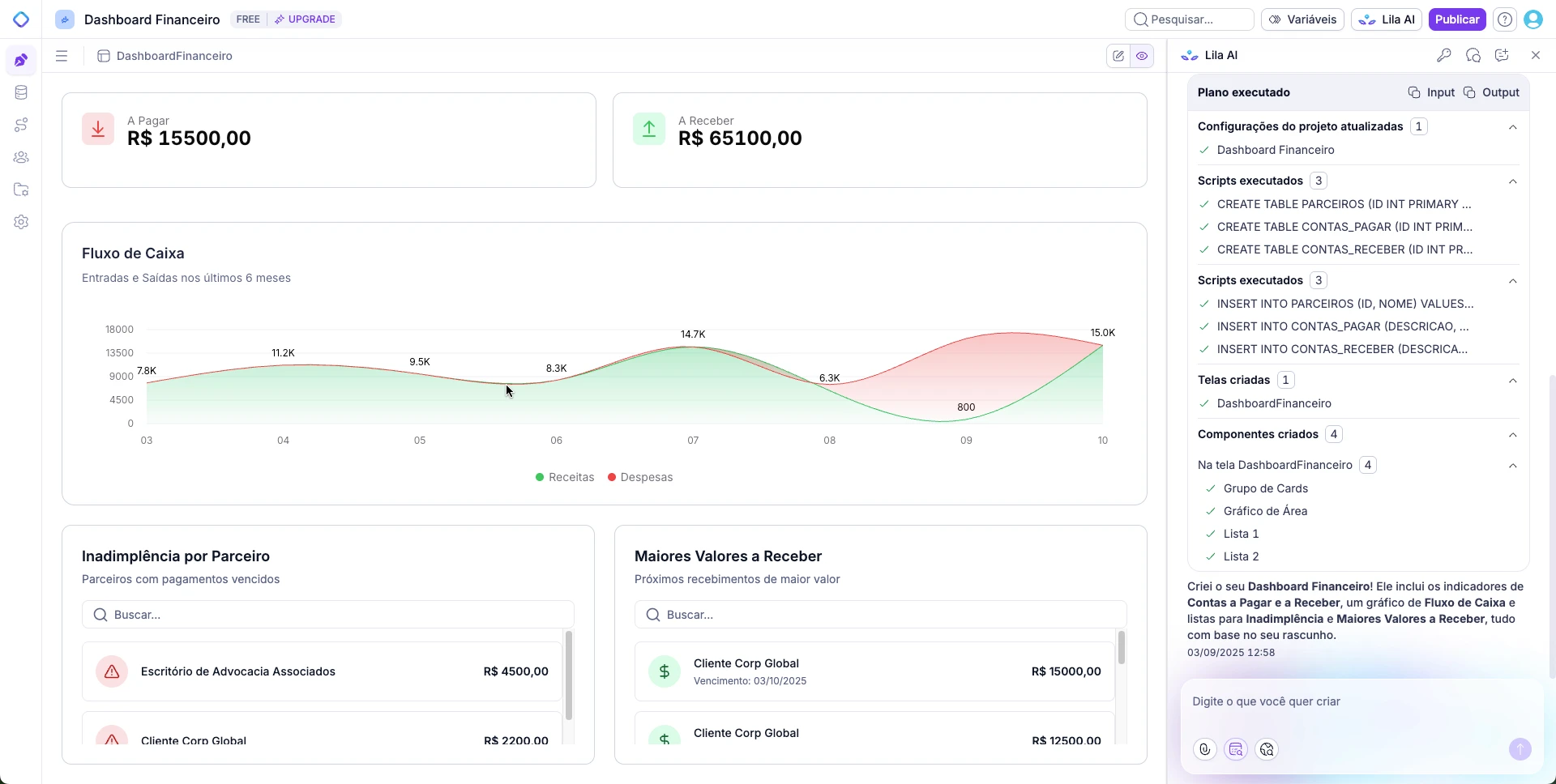
One of the most relevant capabilities for Finance is the AI's ability to generate fully personalized dashboards in just seconds.
Say your Finance team needs to understand movements related to the sales department, for example. Just type "I want a dashboard of sales and margin by state" and the AI automatically builds:
indicator cards,
views by month, profit center, or partner,
navigable charts,
everything already configured on the canvas, ready for adjustments via drag and drop
What previously required a backlog, technical specification, validation, and rework now happens almost instantly. The dashboard is created ready to use, and the team only needs to refine it.
For Finance, this means faster cycles, less dependence on the technical team, and more time for analysis—not for building panels.
Talk to your data: get instant answers to everyday questions
Another profound change is the "Talk to your data" feature. Instead of opening heavy spreadsheets, adjusting formulas, or consolidating inputs, the team simply asks.
Real examples of what the AI answers instantly:
"Where did most of the margin come from?"
"How was product X's performance in the South region?"
"Which costs had the biggest variance this month?"
The AI contextualizes the question, identifies metrics, filters the period, and automatically generates the chart inside Mitra. And every chart is fully navigable: drill down, filters, ABC curve, cities, products, locations—all in real time.
It's the end of the reactive, exhausting process of opening files, building analyses from scratch, or hunting for inconsistencies.
Perform advanced analyses with deep reasoning
As operations grow, time becomes Finance's scarcest resource.
This is where the most powerful layer of Mitra's AI comes in: advanced analysis. Instead of depending on more people to investigate causes, validate numbers, or cross-reference information, the AI does that heavy lifting, with depth, precision, and speed.
With the advanced model used by Mitra, our AI helps you by:
generating composite indicators based on available metrics,
creating strategies to answer open-ended questions,
understanding what the user really wants behind the question,
bringing additional information that makes sense for the analysis.
In practice, this means, for example:
Automatically creating an Income Statement even when the data doesn't come ready.
Finding customers who haven't bought in over 120 days, by salesperson.
Explaining relevant variations: "what happened with product X?".
Comparing specific groups, like salespeople whose names start with a certain letter.
All while navigating through Mitra's entire database, with precision and depth.
Have AI integrated with governance: no more multiple versions
Because all artificial intelligence operates inside Mitra, not outside like spreadsheets, analyses happen:
without risk of conflicting versions,
without consolidation rework,
without formulas that break,
without files circulating between teams.
The AI always works on the same trusted data source, eliminating the fragile environment created by spreadsheets and parallel versions.
It's like having a specialist monitoring your finance daily. Actually, it's like having a full team of finance experts scaling your results without increasing the department headcount.
Direct impacts for the finance team
If this article's premise is clear—scaling results without increasing the team—here you've seen how that promise materializes.
When operations stop depending on manual tasks and start functioning with AI support, Finance gains exactly what was missing: capacity. The team delivers more not because it grew, but because it stopped wasting energy on what doesn't create value.
With this, your company has:
More deliverables without growing headcount
AI eliminates manual tasks and reduces rework. The team produces more with the same structure because it spends less time executing and more time deciding.
Team freed up for strategic analysis
With data consolidated automatically, the team stops "managing spreadsheets" and starts interpreting scenarios, evaluating risks, and supporting leadership with quality information.
Faster closings
With centralized information updated in real time, closing no longer depends on parallel consolidations. The process becomes shorter, predictable, and standardized.
Lighter planning process
Budget, forecast, and simulations become continuous workflows. Parametrizable models reduce complexity, and adjustments can be made without compromising data integrity.
Less overload
Governance, traceability, and collaborative structure reduce dependencies and errors. The team works with less pressure and more clarity, freeing capacity for higher-value initiatives.
AI restores to Finance the space necessary to operate with excellence, prove value, and scale results without needing more people to do the basics. The team doesn't grow in numbers. It grows in impact.
Conclusion: Scaling results begins by scaling the system, not the team
In the end, the equation is simple. Finance's challenge was never lack of talent or analytical capacity. What has always blocked the function is the manual structure that consumes time, creates bottlenecks, and forces the team to operate at capacity.
It's not the team that needs to grow: it's the system that needs to evolve.
When the operational foundation changes, everything changes with it. Cycles become lighter, decisions get faster, errors decrease, and the team returns to the strategic level the company expects. Scaling results stops being a question of people quantity and becomes a question of process quality.
Finance's future isn't in increasing headcount. It's in building an operation intelligent enough to unlock the potential that already exists within the team.
If you want your team to deliver more without relying on new hires, it's worth exploring how an AI-powered structure can transform your financial operation.
Leaders who've made this shift discovered that efficiency comes not from more people, but from better systems.