
Financial decisions are never neutral. They shape margins, unlock (or freeze) investments, adjust the pace of growth, and define board confidence.
And yet, in many companies, a significant portion of these decisions are made on a foundation that nobody can assert with 100% certainty.
Here, we'd like to ask you a simple, but powerful question: "How many strategic decisions has your company made based on uncertain data?"
Because when data originates from a fragile source, the problem doesn't appear as just a numerical discrepancy. It scales quickly and becomes a real operational risk: Without traceability and predictability, the risk isn't just a spreadsheet error—it's compromising EBITDA, cash flow, and board confidence.
That's the point: fragile data doesn't stay confined to Excel. It overflows into results.
Silent errors, conflicting versions, missing audit trails, failed integrations… all of this pushes teams toward bets rather than decisions. And with each closing cycle, budget, or forecast review, uncertainty compounds.
The final truth is that no strategic decision holds up on inconsistent data.
If data presents different versions, if each department works with fields that don't communicate, if there's no clear traceability of adjustments, and if integrations don't maintain a continuous line of trust, the result is always the same: the company loses precision, predictability, and speed.
When AI and organized financial data meet, everything changes

When a company chooses artificial intelligence as its path and manages to structure and standardize its information, something begins to happen almost inevitably: AI stops answering questions and starts executing real work.
Especially in finance, it's capable of understanding tables, relating metrics, interpreting and connecting dots that previously required time, alignment, and rework across departments.
This is the moment the operation shifts gears.
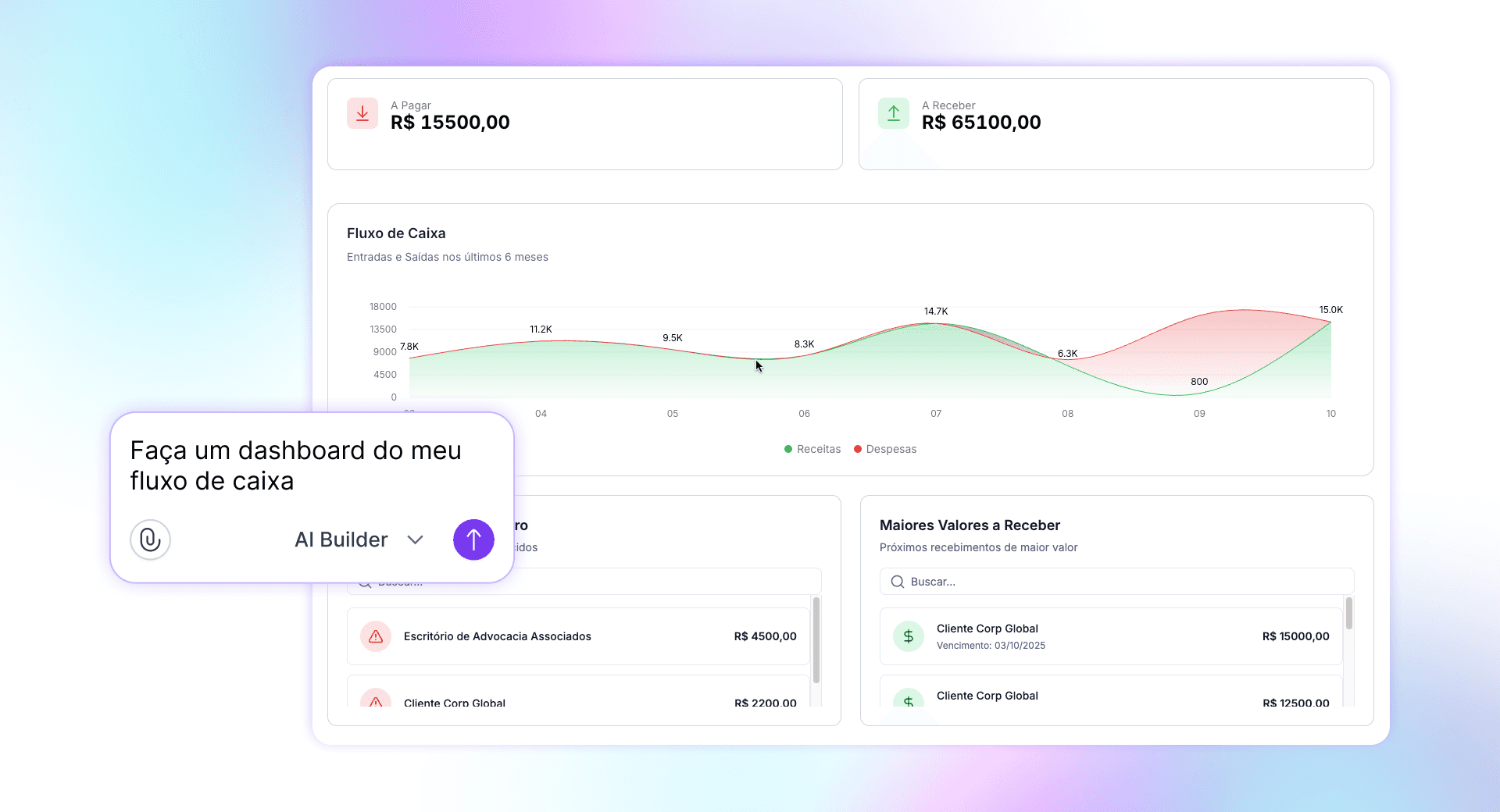
With coherent data, Mitra's AI can create complete dashboards from a single request.
For example: it identifies sales, margin, business units, profit centers, partners, deadlines, and any other element that's already part of the routine.
Instead of navigating spreadsheets, you simply converse with your data and identify sales, margin, business units, profit centers, partners, deadlines, and any other element that's already part of your routine.
In other words: what previously required several steps—requesting a view from the technical team, validating filters, adjusting visualizations, testing versions—now happens in seconds.
And that's not all.
When there's consistency in the database, you can use our AI to interpret drafts, sketches, and loose ideas—without needing everything to be perfect first.
An informal request ("I want to see margin by state, month, and partner") automatically becomes a complete visualization.
A simple adjustment ("make it bars", "turn it into a table") becomes just a gesture, not a process.
In fact, see how a drawing on paper becomes a functional dashboard with Mitra's AI:
Similarly, complex financial flows and internal processes begin to emerge almost as a natural consequence.
Tasks executed 100% by AI, form assembly, report generation—everything begins to flow with less friction, because artificial intelligence understands the context, relationships, and logic behind what's being asked.
This is the key turning point: when data speaks the same language, AI understands and builds along with you, and for you.
Now that you understand the potential impact of this combination, we want to show you some concrete gains: dashboards created in seconds, conversational analysis, complete system building, and everything that becomes possible when AI and data organization work together.
Ready to follow along? Your journey of financial data + AI is just beginning!
Dashboards in seconds: the AI that builds what used to take weeks
When AI and organized data meet, the first visible change happens in dashboards. What used to take weeks—aligning requirements, building each chart, adjusting filters, validating with IT—now takes just a few seconds.
A simple request like "bring me a dashboard on this month's results" and Mitra's AI interprets:
which metrics are relevant,
which dimensions make sense,
how to structure navigation,
and which visualization best translates that context.
In an instant, as you can see when you request a Mitra demonstration, a complete panel appears on screen with information like sales overview, margin, monthly history, regions, channels, categories, customers, or whatever is part of the company's database.
Everything already connected, consistent, and navigable.
And the most interesting part is that personalization remains natural. If someone wants to transform a chart into bars, they just drag the metric to the new visualization.
Prefer a table? Just switch. Want to change the perspective from channel to region, from category to month, from salesperson to product? It's instant.
In other words: it stops being "building dashboards" and becomes interacting with them. AI builds the first version and facilitates every adjustment without technical rework.
Want to dig deeper? Click.
Want another cut? Ask.
Want to turn an insight into a fixed component? Drag.
This jump in speed changes the work logic: instead of losing time building views, your company gains time analyzing, deciding, and acting.
In fact, if you want to clearly visualize the impact of this efficiency on results, Mitra's Budget Loss Simulator shows exactly how much Finance leaves on the table when it relies on slow processes and disconnected data.
Following the thread of this article, now is a good time to suggest a question: what would you ask your data if you could talk to it? Keep reading and you'll discover.
Advanced Analysis: AI Executing Complex Finance Tasks
After instant dashboards and conversational analysis, we reach the point where AI stops simply querying data and starts to reason about it.
This is where Mitra's AI gains even more prominence: it doesn't respond impulsively, doesn't deliver shortcuts; it thinks before answering and solves complex demands.
This behavior enables a type of analysis that no traditional tool can replicate.
When someone in finance has a question they need to clarify, like:
"what's the logic behind this month's margin drop?"
"how has the average ticket for salespeople in group X evolved?"
"what would be a coherent income statement structure based on this data?"
The AI interprets the intention behind the question, identifies all the nuances that need to be considered, chooses the best analysis path, organizes the reasoning, and finally, returns the answer.
It's not a query. It's a process of reflection. AI can:
Build entire structures, like an income statement, without step-by-step instructions
If there's revenue, cost, expense, and margin data, the AI understands the role of each element and organizes everything into a coherent view, even if nobody explicitly defined the income statement layout. It infers the structure, composes the indicators, and delivers ready-made reasoning.
Answer questions requiring non-obvious cross-references
Asking for "average ticket of salespeople in group X" isn't querying a ready-made report; it's interpreting, filtering, crossing tables, calculating, and presenting. AI understands each step of this logic without human intervention.
Deliver more than what was requested
When answering, it doesn't just return the number: it explains why it arrived at that result, points out relevant relationships, suggests additional cuts, and identifies factors deserving attention. It's like receiving the analysis and strategic commentary together.
Create compound indicators with business context
If the question requires combining different metrics, performance by channel weighted by volume, margin by portfolio adjusted for mix, temporal comparisons, the AI understands the role of each metric and composes the indicator naturally.
The result is simple, but transformative: the company gains a continuous reasoning layer over its data. An intelligence capable of interpreting, justifying, comparing, and suggesting paths, without depending on technical instructions or manual assembly.
And the journey doesn't end here. Now that AI can analyze deeply and explain clearly, the next step is to show how it also builds: screens, flows, processes, and entire systems—in the next section of this blog post.
From Drawing to System: Complete Applications Built by AI
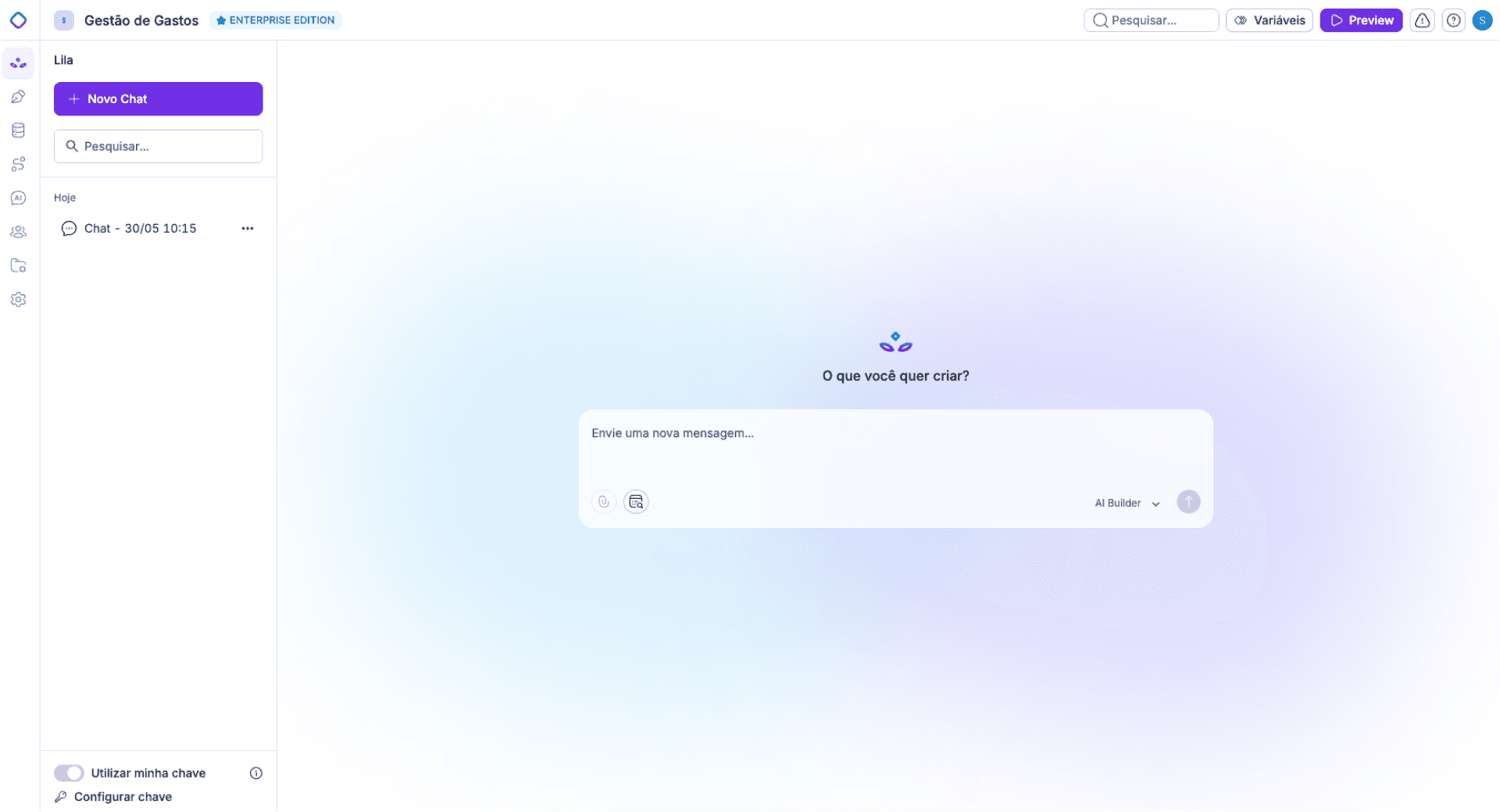
If instant dashboards and advanced analysis already show the productivity leap, this is the point where Mitra's AI reveals something even more surprising: it doesn't just analyze, it builds.
And it really does build.
Behaviors that until recently required weeks of development, cross-departmental alignment, technical validation, and countless back-and-forths now happen in a natural, almost conversational flow.
Transform a rough sketch into a functional dashboard with AI
Just take a photo of a sketch—even those quick drafts, scribbled hastily during a conversation—and the AI identifies:
which components belong to each quadrant,
which metrics make sense in each block,
which visual structure represents what was imagined,
and builds the complete screen, ready to use.
You don't need to specify anything. The AI understands the intention behind the drawing and materializes in seconds what previously would take someone days to model.
Create screens, flows, and components automatically
Forms, lists, cards, calendars, fields, visual integrations—everything is generated based on what the person describes or sketches.
If the company needs an approval flow, a request list, a delivery tracking board, or an internal indicators dashboard, just say what you want.
AI builds:
the interface,
the fields,
the rules,
the action flow,
and the necessary navigation.
Work with governed and already-understood data
Because data logic is already integrated, AI automatically recognizes:
what data is a metric,
what data is an attribute,
how they relate,
how they need to appear on screen,
and how to feed flows with consistency.
Everything connects without manual programming, because the system already knows the structure.
AI corrects itself when something doesn't turn out as expected
If a screen came incomplete, if a metric appeared in the wrong place, or if the user asked for something slightly different, just trigger the "correct" command. AI adjusts the component, reorganizes the logic, and delivers the revised version without structural rework, without breaking anything that already exists.
Bonus: create complete mobile applications
AI doesn't stay confined to the desktop screen. The same intelligence that builds dashboards and internal systems also creates complete mobile applications:
mobile-optimized screens,
fluid navigation,
filters, lists, and native forms,
automatic generation of responsive components,
and integration with central data.
What previously required a dedicated mobile development team now becomes an accessible process for any department.
The impact of this capability is profound: ideas that used to die on paper come to life in minutes.
Flows that were shelved become internal products, and processes that relied on IT gain autonomy.
Imagine the impact when construction stops being a bottleneck and becomes an accelerator.
Want to see how this happens in practice? Ask a real question about your Finance in a demonstration and see how Mitra builds the answer: structured, contextualized, and with the reasoning you'd expect from an experienced analyst.
In the next section, we advance to the next step of this revolution: how this same AI acts as an analyst who executes processes, assigns tasks, summarizes activities, and sustains operations day-to-day.
AI as the New Analyst: Automations, Processes, and Ready-Made Routines

From the moment AI understands the structure of data and internal flows, it stops being just an analysis tool and begins to act as an operational analyst by creating, executing, and organizing entire routines.
The change will be felt by your Finance department quickly:
Routine Tasks Executed by AI
Email sending, alerts, reminders, weekly summaries, status updates, and delivery tracking emerge as automatic flows created by AI itself based on a simple description.
Complete Internal Processes
Flows like reimbursement, internal requests, approvals, and support gain life quickly: forms, rules, steps, alerts, and reports are assembled by AI without technical intervention.
Ready-Made Management Components
AI creates kanban boards, calendars, Gantt charts, smart lists, and operational dashboards that update themselves as automations execute tasks.
Portals, Documents, and Signatures
It also generates support portals, customer pages, tracking screens, automatic PDFs, ready-made documents, and even flows with integrated digital signatures.
Complete Applications and Modules
AI creates complete screens and functionalities, including mobile versions, forms, support pages, and internal modules used by different teams.
In summary: AI assumes part of the operational work, freeing up team time for decisions, strategy, and results, while it handles continuous and frictionless execution.
Conclusion: In the End, It All Comes Back to Data, and What You Do With It
When well-structured data meets artificial intelligence, financial operations shift to a new level.
Dashboards are born in seconds, deep analysis happens in a conversation, and entire systems take shape from an idea. Work stops being assembly and becomes decision-making.
With an organized foundation, AI understands context, connects dots, creates indicators, automates routines, and builds entire flows. It amplifies team capacity, accelerates execution, and transforms processes that previously depended on manual effort into continuous results.
Traceability, consistency, and standardization stop being technical details and become the foundation for unlocking all this potential. When the company has clarity about its data, AI operates with precision, fluidity, and direct impact on Finance's daily operations.
The final point is simple and inspiring: organized data isn't just a resource: it's a multiplier.
And when AI enters the scene, that multiplier becomes a competitive advantage, opening space for better decisions, faster cycles, and operations that grow with confidence.
If you want to see all of this happening in practice and understand how AI can elevate your Finance to the next level, get to know Mitra. Your transformation starts with a simple first step: request a free demo.