
You no longer build the budget: now you talk to it.
For years, corporate budget planning was synonymous with complex spreadsheets, conflicting versions, manual consolidations, and a process that consumed weeks to deliver a snapshot that was already outdated the moment it was finished.
With the rise of generative AI in the business environment, this model began to change, but only for companies that managed to connect AI to their corporate data, internal processes, and business rules.
This is where a new frontier emerges: talking to data to build real systems, not prototypes.
This is the foundation of a model that combines AI, automation, and low-code to enable teams to develop corporate applications directly from conversations.
In other words: instead of generating isolated artifacts, AI works within a prepared environment: integrated database, structured components, business logic, security, and governance.
The result isn't just a simple idea—it's a living, connected, and scalable system.
In the context of budget planning, this means something simple yet transformative:
you can ask AI to build the budget structure, connect historical revenue, expense, and cost series, generate automatic projections, create scenarios, and turn all of that into a complete planning workflow.
And all of this without spreadsheets and without relying on manual review cycles.
Technology stops being an accessory and becomes a direct driver of speed, intelligence, and governance. Planning stops being a static document and becomes a system born from conversations and evolving with the business.
Follow along with us, because today we're going to explore how talking to data—this seemingly simple gesture, yet so significant in possibility and impact—is redefining budget planning and taking finance to a new level of intelligence.
The current context and the new paradigm of Data Conversation
Most companies still do budget planning as if we were in 2005: spreadsheets, duplicate tabs, versions where nobody knows which one is correct, and decisions that arrive too late.
Nearly 96% of FP&A teams use Excel as their primary budgeting and reporting tool, according to recent global research.
But a new paradigm is emerging: companies that have migrated to specialized planning software and AI are already seeing the benefits.
Leading the way are those that can align speed, data clarity, and governance, leaving behind rework, silent spreadsheet errors, and delayed decisions from conflicting versions.
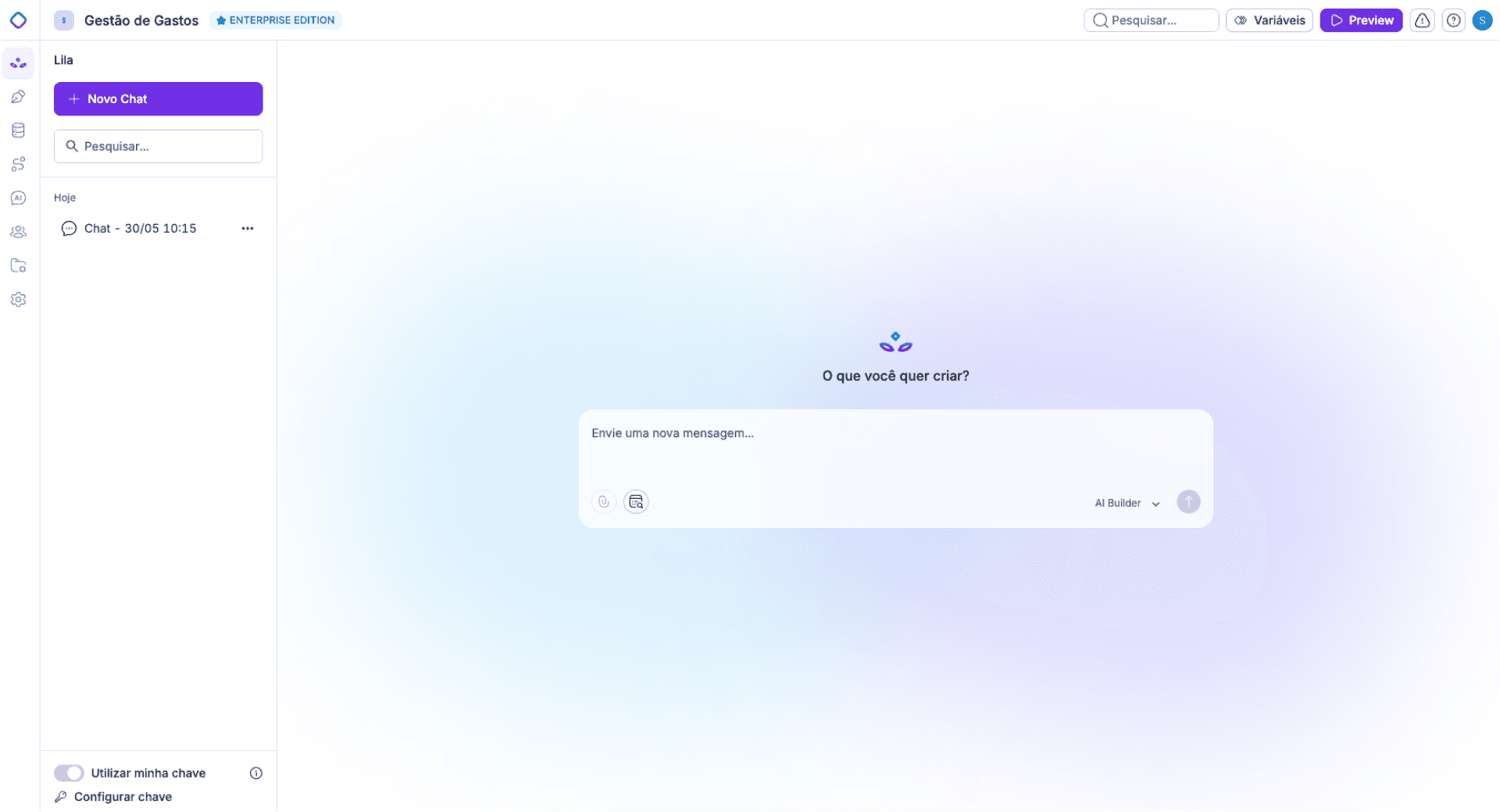
The new paradigm of data conversation is simply asking AI for what you need it to analyze.
One example is asking Mitra's AI to "build my budget planning for the next cycle, considering revenues, expenses, costs, and scenarios, with real data and robust automations."
When our AI operates on a structured corporate foundation, the result isn't a prototype: it's a system ready to guide the future of the business.
The conceptual leap: from prompt to corporate application
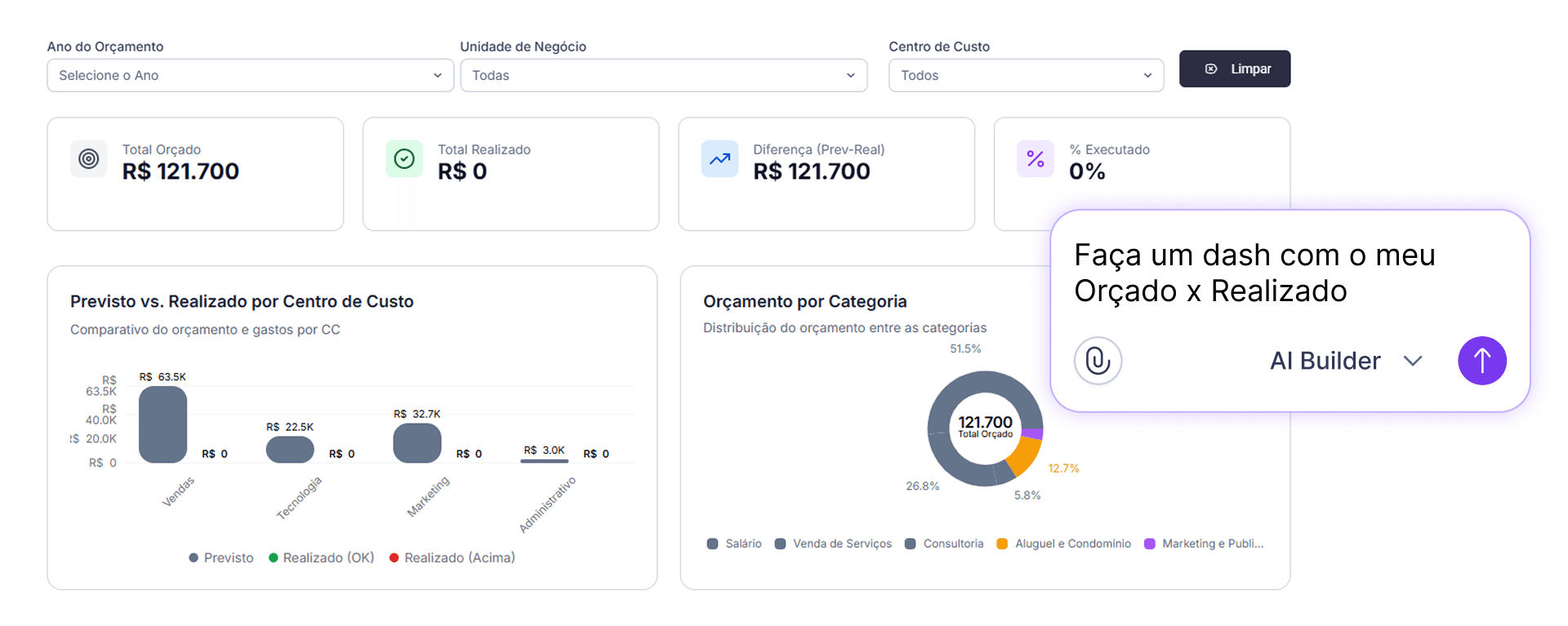
Prompts—the commands you give to an AI—serve for much more than generating prototypes.
And the real advancement of Mitra's AI begins when conversations stop creating isolated demonstrations and start generating corporate applications that solve classic Finance Department pain points.
This is exactly the point that differentiates the approach used by most companies from what Mitra proposes.
Using AI disconnected from data and internal processes limits potential and prevents solutions from advancing to production. When AI operates in a prepared environment, with data, rules, and integrations, building stops being experimental and becomes operational.
Mitra operates in exactly this model.
AI doesn't start from zero. It builds within a corporate environment that already brings together a database, logic, structured components, automations, security, and native integrations.
That's why an application can be born from a conversation and transform into a real, fully integrated, and sustainable system within your company.
Talking to data is more than just "prompting"
Talking to data in Mitra is possible because the platform already brings together everything a corporate application needs to exist:
Integrated database,
Logic,
Structured components,
Automations and governance.
These elements form the foundation that enables AI to build complete systems from a simple natural language interaction.
In other words: you say what you need and AI assembles a complete corporate application with built-in analytics and enterprise security.
That simple.
When your company's data enters this environment—imported via API, CSV, XLS, or JDBC connectors—our AI:
Interprets historical trends,
Identifies patterns,
Records internal parameters
Organizes recurring information.
➦ This includes revenues, expenses, costs, targets, constraints, and any relevant set of financial data your company centralizes in Mitra.
Then, after structuring your data, you speak and you receive:
Structured projections based on real data,
Organized scenarios,
Automated workflows,
Intelligent dashboards
A system ready to operate within your company's governance framework.
This is the essential difference between simply asking something of a language model and building budget planning within a prepared corporate environment.
In Mitra, the conversation doesn't end at text—it converts into the solution you need.
Practical application: creating budget planning through conversation
Why does this change everything?
When budget planning stops happening in isolated spreadsheets and starts happening in a corporate environment with AI, the entire logic of work changes.
Teams leave behind practices that hold back operations and prevent finance from moving forward.
Companies stop:
Copying and pasting data between spreadsheets
Working with outdated information
Depending on IT for every adjustment
Repeating a manual model that consumes time and increases the chance of error
And start:
Creating planning systems in days, because AI builds complete applications from a natural language description
Updating projections automatically, since data is integrated within the environment
Operating with connected intelligence, combining data, logic, and analytics in one place
Ensuring security and governance at every step of the process
Making decisions based on current and accessible information
Reacting to changes before they affect results
The impact goes beyond technology. It's in speed, clarity, and the ability to transform a traditionally slow process into a living system that matches your business pace.
Final thoughts
The future of budget planning isn't a new spreadsheet template: it's a new way of talking to data.
With AI connected to the corporate environment, finance stops filling cells and starts architecting scenarios, testing hypotheses, and anticipating decisions.
Planning stops being a document and becomes a living system.
Want to see what your Finance department would look like with Mitra? Let us show you.