
The year 2025 left a clear lesson for medium and large organizations: the challenge wasn't a lack of data, nor a lack of team talent, but rather how work and technology were structured.
In many cases, business growth came with more demands, shorter deadlines, and greater pressure for accuracy, while team sizes remained practically unchanged, or even shrank.
This mismatch exposed a systemic problem: in practice, what emerged was a multiplication of tools, spreadsheets, and parallel workflows created to "keep up" with the growing volume of work.
The result was a fragmented operational environment, marked by manual consolidations, conflicting versions, and strong dependence on key individuals.
Much of teams' time became consumed not by analysis or decision-making, but by preparatory activities: organizing data, checking formulas, validating numbers, and reconciling scattered information
This scenario helps explain why so many teams began simultaneously seeking greater clarity, less complexity, and more autonomy.
Autonomy was necessary to reduce bottlenecks and accelerate responses. Clarity was needed to restore confidence in the numbers and support critical decisions. The problem is that without adequate structural foundation, these two demands began to compete with each other.
The issue is that spreadsheets were not designed for critical business processes, precisely because they don't offer sufficient governance, traceability, and security when used as an operational backbone.
What 2025 revealed wasn't a competency crisis, but a structural one: qualified teams trying to operate in models that don't scale, generating friction between data and decision-making and limiting the real capacity to move forward.
Now, in 2026, teams have another opportunity to bring more order to this chaos and better leverage their data to transform it into decisions.
Keep reading to understand better what we're talking about.
Why clarity and autonomy shouldn't compete with each other

It's not uncommon to still see clarity and autonomy treated as opposing forces.
On one hand, the more control and standardization are imposed, the less freedom teams seem to have to act and even adapt.
On the other, when autonomy is expanded without a common foundation, conflicting versions of reality emerge, misaligned decisions, and loss of confidence in the numbers.
The problem isn't in pursuing one or the other, but in not understanding what actually sustains both at the same time.
The concept of financial maturity helps resolve this false dilemma.
As we saw in one of our previous articles, From Prompt to Budget Planning, maturity isn't just closing the month or fulfilling operational rituals. It's having continuous visibility, consistent data, and the ability to anticipate.
You need to shift from a reactive model to a predictive one
Notice how, at the point we just discussed, clarity stops being synonymous with bureaucracy and becomes the infrastructure that enables distributed decisions with confidence.
And when data is reliable, up-to-date, and shared from a single source of truth, teams gain context. This context is what enables autonomy.
Without it, freedom becomes improvisation. If you read the post From Chaos to Control, weak data doesn't produce decisions, it produces bets: silent errors, multiple versions, and lack of traceability push areas toward "gut feeling," not analysis
In this scenario, any attempt to decentralize decisions tends to amplify the chaos.
The opposite is also true. Clarity without autonomy creates slowness. When every question depends on manual consolidations, successive validations, or technical intermediaries, response time lengthens and data arrives too late to influence strategy.
Financial maturity, therefore, doesn't choose between clarity or autonomy. It builds an environment where clarity is structural and, precisely because of that, autonomy becomes possible, safe, and scalable.
How the quest for agility became the rule, and where it starts to fail

The pressure for agility has become a competitive standard: companies need to respond faster, decide sooner, and adjust course in increasingly shorter cycles.
The problem is that in many cases, this speed was pursued without reconsidering the structure that supports the work. Accelerating fragile processes with low-code without governance, isolated scripts, or disconnected dashboards only amplifies errors and creates what has already become common in 2025: an invisible operational debt.
As shown by the discussion on scaling results without increasing team size, more velocity on a fragile foundation doesn't generate efficiency; it generates rework, dependence on key people, and growing risk
This scenario worsens when multiple data versions coexist, pushing the organization toward slow decisions or poorly informed bets, a recurring pattern in environments without structural control.
When control stops blocking and starts structuring
In companies that operate critical processes, control is not a luxury or a hindrance: it's the minimum requirement for agility to be sustainable.
As data, workflows, and decisions gain direct impact on business results, the absence of governance generates more slowness than speed. Discussions about versions, manual validations, and rework consume time that should be dedicated to decision-making.
This is the point where control stops being perceived as bureaucracy and starts acting as structure. Governance, business rules, access control, and traceability don't exist to limit teams, but to ensure everyone operates from a single, reliable, and auditable foundation.
When this foundation exists, decisions no longer depend on parallel reviews and happen within the flow of work.
Mitra's proposition is born from exactly this premise. By replacing spreadsheets with governed corporate applications, the platform transforms control into a native component of the process rather than an additional step at the end.
Centralized data, automatic versioning, clear validations and permissions eliminate ambiguities and reduce operational risk, while accelerating planning, analysis, and execution cycles
In other words: in practice, control stops blocking movement. It organizes, provides predictability, and creates the environment necessary for agility to happen without improvisation and on the required timeline.
The leap of AI: from generating insights to building complete systems
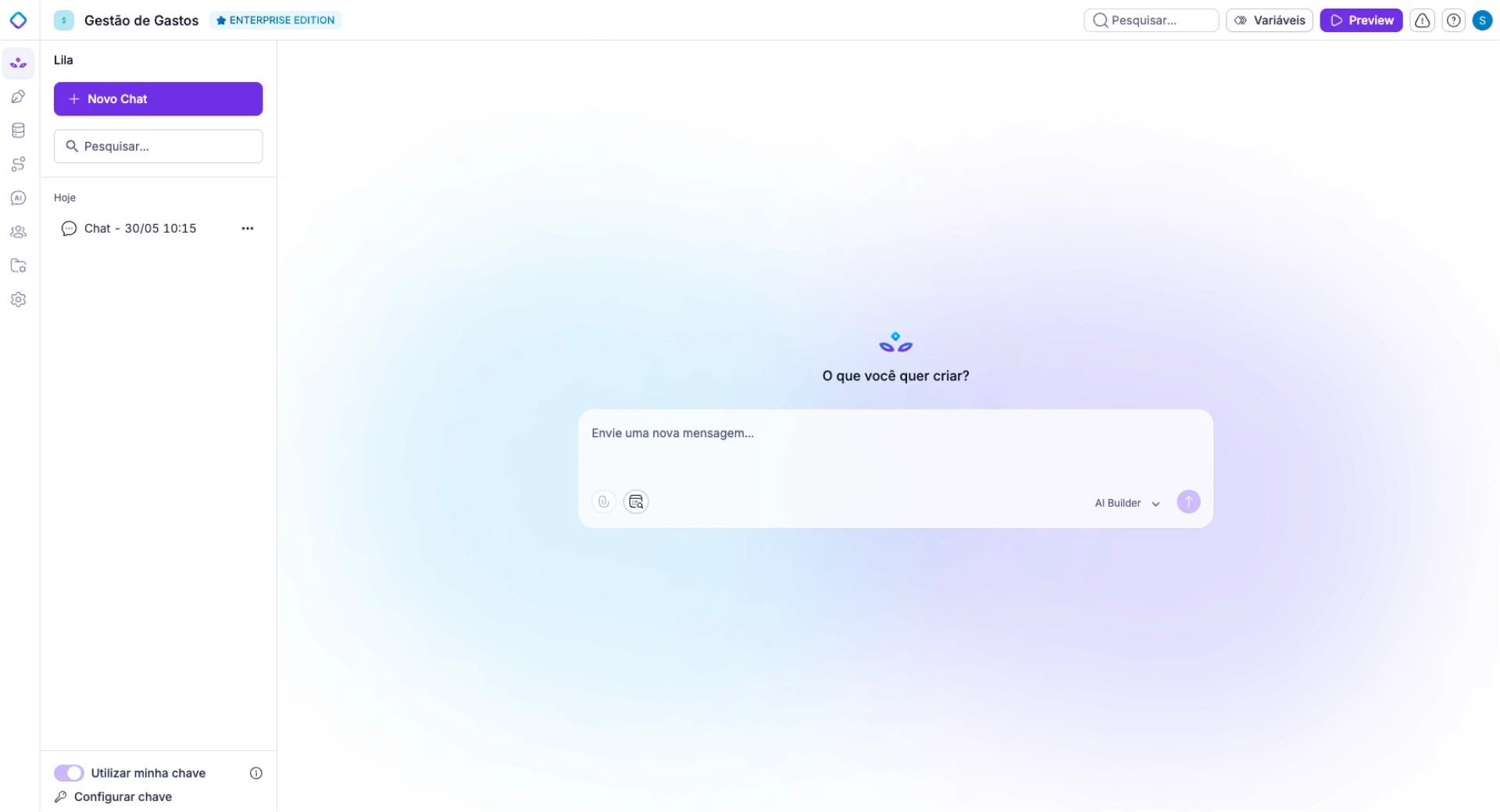
For a long time, AI applications in the corporate environment were limited to analysis, answering questions, generating text, creating isolated projections, or supporting specific decisions.
These uses brought gains but maintained a clear limitation: the distance between insight and execution. What begins to change this scenario is the transition from AI as a consulting tool to AI as a building agent.
Mitra's proposition is anchored precisely in this shift.
Instead of operating on loose data or generic contexts, AI works within a prepared corporate environment where databases, business logic, governance, integration, and interface are already part of the system
All this enables a conversation to stop generating just answers and start giving rise to complete applications, ready to operate.
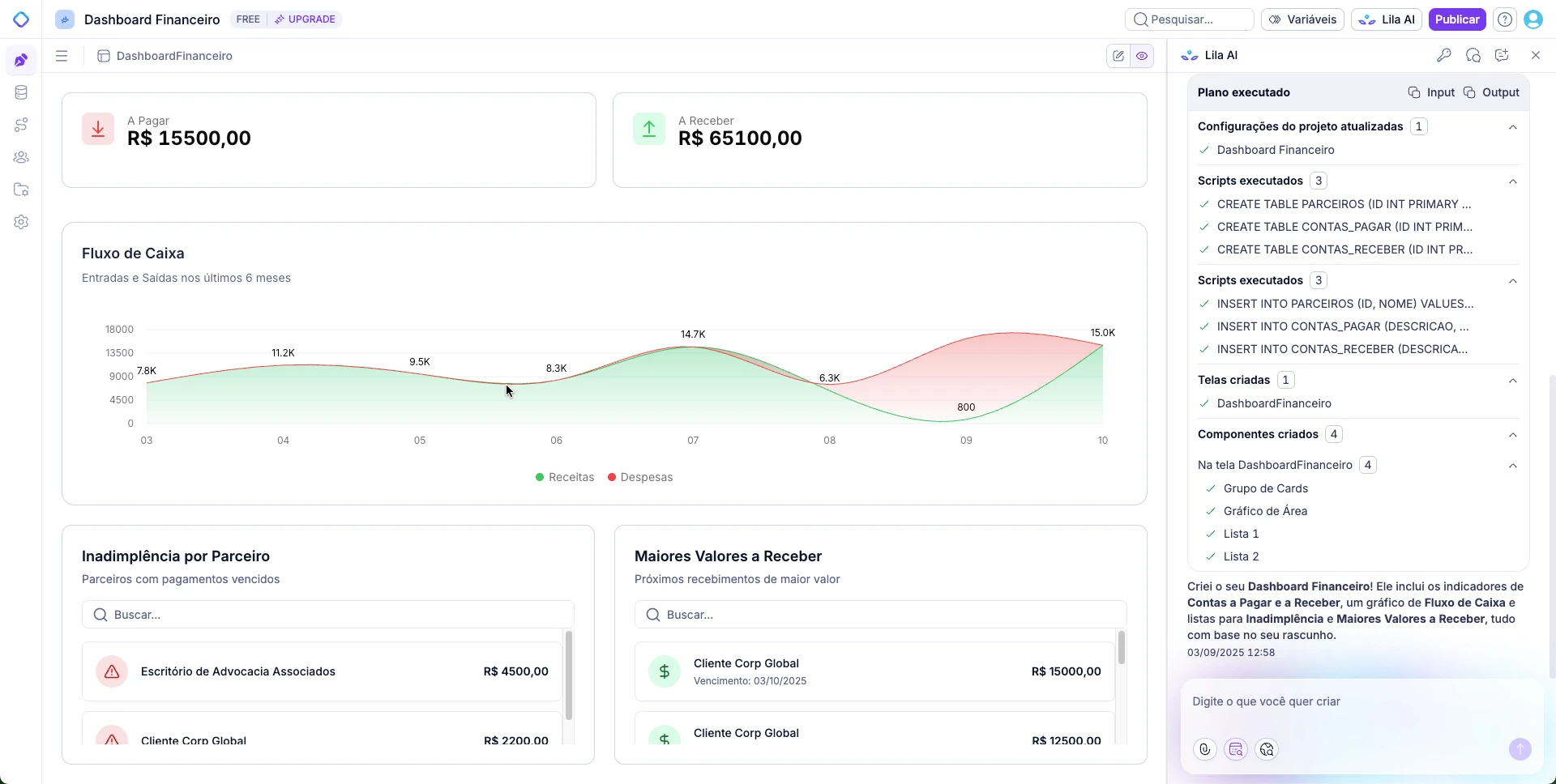
The logic is simple and powerful: you describe what you need (a workflow, a process, a planning system, a control mechanism) and AI builds the corresponding system.
Not just dashboards, but structures with integrated data, clear rules, automatic validations, analytics, and corporate security
Notice how the conversation evolved into creating a complete application, fully functional and built for your specific need. It's your application, not an application that happened to fit your need.
In simple terms, this solution is a living system that was born to support your business.
This approach differentiates "AI for analysis" from "AI for building".
While the former answers, the latter executes real work. As discussed in the post From Chaos to Control, when AI operates on organized and governed data, it stops being just an analyst and begins assuming part of the operational execution.
In practice, you start creating workflows, automating routines, and sustaining critical processes continuously, not just circumstantially.
This is the point where AI stops supporting isolated decisions and starts structuring operations.
Why corporate environments demand a different logic
Every company reaches a point where deciding faster stops being the challenge.
But the real challenge becomes deciding better, with confidence, every day. Not just at month-end close, not just in annual budgeting, but in the middle of the game, when there's still time to correct course.
This is when it becomes clear that scaling decisions isn't about creating more dashboards, reports, or point-in-time analyses.
It's about building a system that sustains the business in motion. A system where data doesn't need to be checked, where numbers don't spark debate, and where every decision carries context, accountability, and clear impact.
Mitra wasn't designed to "analyze better," but to operate better. To transform scattered data into a single, living, governed foundation. To take finance out of reactive mode and place it at the center of strategy, influencing the future instead of explaining the past.
When finance starts functioning as a continuous system, something shifts in the entire organization. The conversation moves away from the spreadsheet, the noise disappears, and decisions flow. Teams gain autonomy without losing control. Leadership gains predictability without losing speed. And the company gains something rare: the ability to grow without improvising.
In the end, it's not about technology. It's about maturity.
And Mitra exists to enable exactly that for any company that understands that deciding well isn't an event, it's a competency.
Want to see how Mitra would work in your context? Schedule a demo!